
Looking for something new and fresh for your social studies class? Try the Sticky Note Challenge for Social Studies!
Teaching social studies is always a delight for me, but sometimes I need to shake up my classroom activities a bit to keep students excited and interested in the subject matter while also integrating reading and writing practice.
From personal experience, I can tell you that few things excite students more than being turned loose with a pack of sticky notes…
I find that students do some of their best analysis when they use sticky notes. Maybe there’s something in the glue?
The Sticky Note Challenge will help you connect social studies, reading, and writing in a fun, meaningful way.
Before diving into the specifics, be sure to grab my free full-color Sticky Note Challenge chart to display in your classroom or for students to keep in their social studies folders.
The beauty of sticky notes is that they can go nearly anywhere, including classroom doors, interactive notebooks, folders, textbooks, chapter books, large chart paper, and more!

🖊️ I do recommend that you allow students to use black ink pens on their sticky notes because ink shows up better than pencil on sticky notes.
➡️ You can certainly use small sticky notes, but I recommend 3 inch x 3 inch sticky notes.
Are your students ready for the Social Studies Sticky Note Challenge?
Let’s talk about the meaning of each sticky note color…
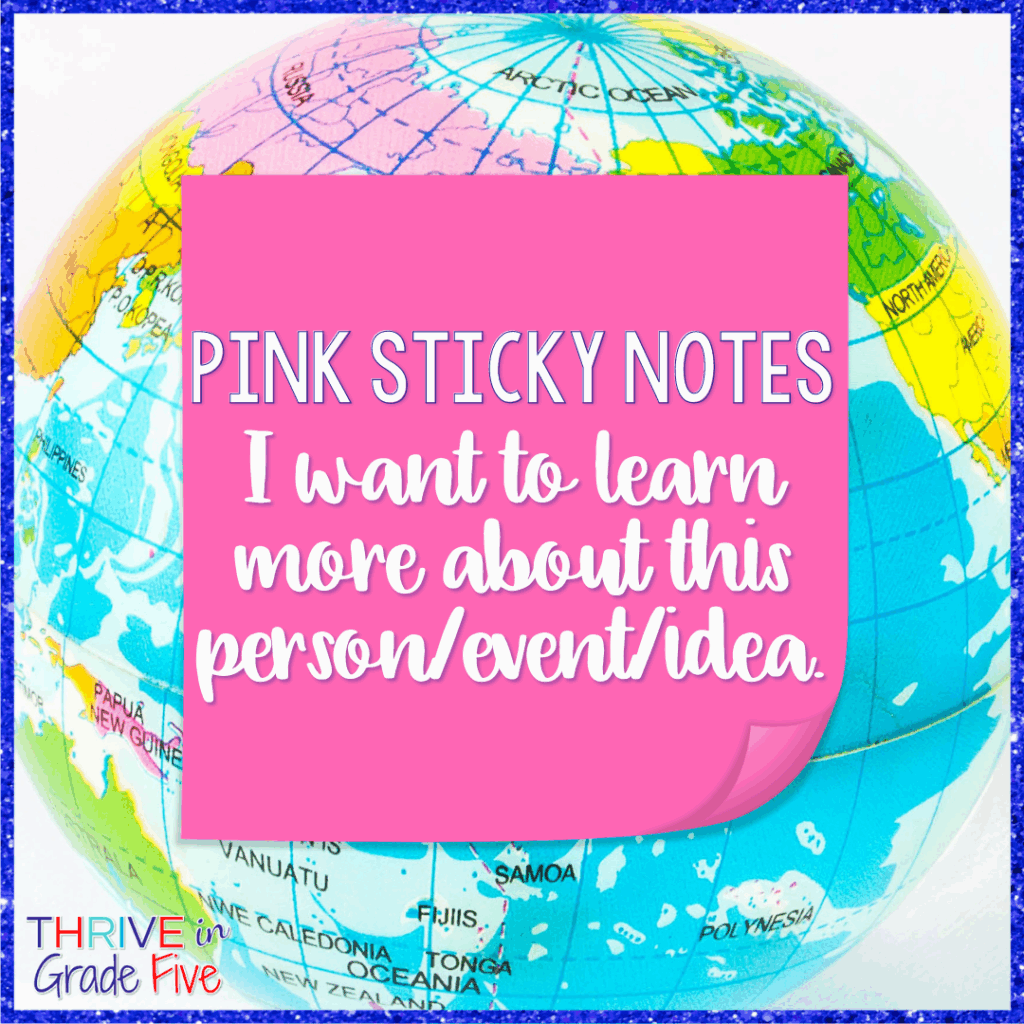
Pink Sticky Notes: I want to learn more about this person, event, or idea!
Students should use pink sticky notes to make note of individuals, events, and ideas they would like to investigate further.
Classroom Examples:
🤩 A student is reading about the Battle of Bunker Hill and comes across an interesting tidbit about Major General (Dr.) Joseph Warren. He wants to investigate Warren further, so he jots a quick reminder on a pink sticky note.
🤩 When a student reads a historical fiction book involving a Quaker child, the student might want to learn more about the Quaker way of life. This would be great message to write on a pink sticky note for research at a later time.
🤩 A student reading a text about the Great Depression will find out that eggs cost about 18 cents per dozen and a student could attend Harvard for $420 per year. It might be a good idea for the student to write down these facts and a reminder to look more into the prices of items and individuals’ buying power during the Great Depression.

Orange Sticky Notes: Important Vocabulary Words or Individuals
Students should use orange sticky notes to make note of important vocabulary words or individuals.
As the teacher, you’ll need to decide if you want students to make sticky notes for predetermined vocab words and individuals OR if you want more of a “free choice,” in which students themselves decide which words and individuals are most important to put on their sticky notes.
Classroom Examples:
🤩 A student is reading a chapter book and comes across the word splendiferous. She has never seen that word before and she wants to remember it for later when she writes her reading response paragraph. So, she looks up the definition in a dictionary and makes an orange sticky note for the word.
🤩 When reading about the American Revolution, a student will learn about the contributions of the Marquis de Lafayette. The student will want to mark where he appears in the text and write his main role on an orange sticky note.
🤩 While reading in her textbook about Union leaders during the Civil War, a student is confused about the relationship between Abraham Lincoln and Ulysses S. Grant. It would be good use of an orange sticky note to write a question and save it for later discussion.
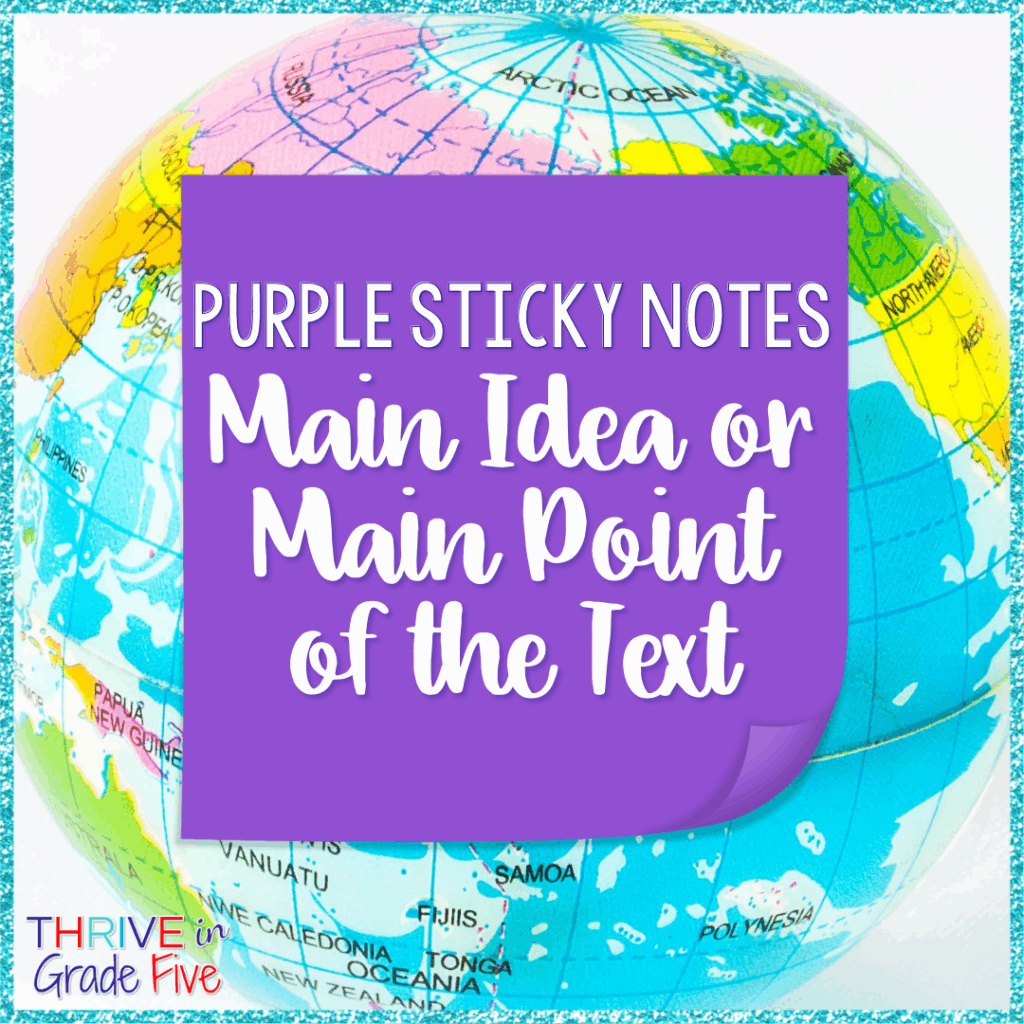
Purple Sticky Notes: Main Idea or Main Point of the Text
Students should use purple sticky notes to write down the main idea or main point of the text.
Deciding on the main idea or main point of the text and writing it on a sticky note helps students to keep focus on the main idea as they read.
Writing down the main idea or main point of a text is excellent practice for ELA as well.
Classroom Examples:
🤩 If a student is reading a primary source text about Jamestown’s Starving Time, it might be helpful for her to write the main point of the text on a purple sticky note and add 2-3 sub points on the sticky note to help her maintain focus on what is most important.
🤩 A student is reading an informational text about the Boston Tea Party. After her first cold read through, she jots down the main idea of the text on a purple sticky note using this sentence starter: The Boston Tea Party was a protest carried out by the Sons of Liberty to protest the Tea Act.
Blue Sticky Notes: Text-to-Text Connections
Students should use blue sticky notes to jot down connections from the text they are reading to another text that they have read.
Classroom Examples:
🤩 A student is reading about the early settlement created at Plymouth Plantation. This settlement reminds them of a few details they learned about the early Jamestown settlement. The student uses a blue sticky note to write down the similarities they noticed between the text they are reading and the text about Jamestown that they read previously.
🤩 While reading a fictional account of a boy who witnessed the Boston Massacre, a student may connect the text with a previously read chapter book in which a child witnessed a crime. This would be a good text-to-text connection to write on a blue sticky note.
🤩 While studying economics concepts, a students might make a connection between supply and demand in their textbook with the Tea Act they learned about in their American Revolution book. This is a connection that would look great on a blue sticky note!

Yellow Sticky Notes: Text-to-Self Connections
Students should use yellow sticky notes to jot down connections from the text they are reading to things they’ve experienced in their own lives.
Helping students start to connect text to their own lives is a highly valuable ELA skill and just a life skill in general.
If students can “see” themselves in texts and books, their reading experience becomes much deeper and more meaningful.
Classroom Examples:
🤩 A student reading about the Preamble to the Declaration of Independence will learn about life, liberty, and the pursuit of happiness. He might add a yellow connection sticky note to share that life, liberty, and the pursuit of happiness is printed on the wall at his mom’s workplace.
🤩 A student reading a historical fiction chapter book about the Underground Railroad might be drawn into thought about what she would do if she were in the book character’s position. She should write her thoughts on a yellow sticky note.
🤩 If a student reads a text about a historical person worried about a lost item, the student might connect this text to the time her mom was panicked because she lost her keys at the amusement park. This connection would be written on a yellow sticky note.

Green Sticky Notes: Text-to-World Connections
Students should use green sticky notes to write connections that they make from the text to the world.
Classroom Examples:
🤩 When a student reads a chapter book in which a family is driving and a police officer pulls over their car, the student might connect that part of the book to when they’ve seen a car being pulled over and what they know about the 4th Amendment right to privacy.
🤩 When reading about the Columbian Exchange, a student will notice familiar spices and foods mentioned in the text. It would be an excellent use of a green sticky note to jot down the connections that can be made between foods made possible through the Columbian Exchange and foods that the student enjoys.
🤩 A student reading a historical fiction chapter book about a family living on a farm in the 1700s might be able to connect what they are reading with what they learned during the dairy field trip last year.
Before you leave, be sure to grab my free, full-color Sticky Note Challenge chart to display in your classroom or for students to keep in their social studies folders.

If you’d like to keep this post for later, simply save this image to your teacher Pinterest board!
Click here to check out my suggested products to use during this Social Studies Sticky Note Challenge.
*** Amazon Affiliate Disclaimer: Please note that I do earn small commissions, at no cost to you, when a teacher buys on Amazon using my suggestion link. ***